
Animal Brains
Task
Is there an association between the weight of an animal’s body and the weight of the animal’s brain? 1. Make a scatterplot using the following data.
| Animal | Body Weight (kg) | Brain Weight (g) |
|---|---|---|
| Mountain beaver | 1.35 | 8.1 |
| Cow | 465 | 423 |
| Grey wolf | 36.33 | 119.5 |
| Goat | 27.66 | 115 |
| Guinea pig | 1.04 | 5.5 |
| Asian elephant | 2547 | 4603 |
| Donkey | 187.1 | 419 |
| Horse | 521 | 655 |
| Potar monkey | 10 | 115 |
| Cat | 3.3 | 25.6 |
| Giraffe | 529 | 680 |
| Gorilla | 207 | 406 |
| Human | 62 | 1320 |
| African elephant | 6654 | 5712 |
| Rhesus monkey | 6.8 | 179 |
| Kangaroo | 35 | 56 |
| Golden hamster | 0.12 | 1 |
| Mouse | 0.023 | 0.4 |
| Rabbit | 2.5 | 12.1 |
| Sheep | 55.5 | 175 |
| Jaguar | 100 | 157 |
| Chimpanzee | 52.16 | 440 |
| Mole | 0.122 | 3 |
| Pig | 192 | 180 |
- Do there appear to be outliers in this data? Which animals appear to be outliers? Explain how you identified these outliers.
- Removing the outliers from the data set, make a new scatterplot of the remaining animal body and brain weights.
- Does there appear to be a relationship between body weight and brain weight? If yes, write a brief description of the relationship.
- Take a piece of uncooked spaghetti and use that spaghetti to informally fit a line to the data. Attempt to place your line so that the vertical distances from the points to the line are as small as possible.
- How well does the spaghetti line appear to fit the data? Explain.
IM Commentary
This task is designed as an instructional task. You will need to provide each student with a piece of uncooked spaghetti.
The purpose of this task is for students to create scatterplots, and think critically about associations and outliers in data as well as informally fit a trend line to data. This task provides an example of how students could informally fit a line to bivariate data without using technology to “magically” make the line appear. By using spaghetti rather than drawing a line, students can easily make adjustments on the placement of the line. They can also easily see points on both sides of the line as they are trying to fit the line to the data.
Solution
-

Yes there appear to be two outliers. The outliers are the African Elephant and the Asian Elephant. The points corresponding to these two animals are very far away from the rest of the data. -
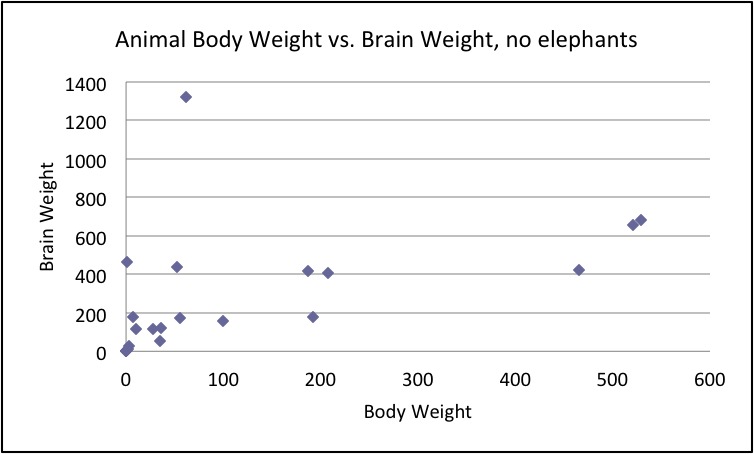
- Yes, there appears to be a relationship between body weight and brain weight of animals. The relationship looks roughly linear and the relationship is positive. Larger brain weights tend to be paired with larger body weights.
-

- The spaghetti line fits the data fairly well although the human has a brain weight that is very large given the weight of the body.
Animal Brains
Is there an association between the weight of an animal’s body and the weight of the animal’s brain? 1. Make a scatterplot using the following data.
| Animal | Body Weight (kg) | Brain Weight (g) |
|---|---|---|
| Mountain beaver | 1.35 | 8.1 |
| Cow | 465 | 423 |
| Grey wolf | 36.33 | 119.5 |
| Goat | 27.66 | 115 |
| Guinea pig | 1.04 | 5.5 |
| Asian elephant | 2547 | 4603 |
| Donkey | 187.1 | 419 |
| Horse | 521 | 655 |
| Potar monkey | 10 | 115 |
| Cat | 3.3 | 25.6 |
| Giraffe | 529 | 680 |
| Gorilla | 207 | 406 |
| Human | 62 | 1320 |
| African elephant | 6654 | 5712 |
| Rhesus monkey | 6.8 | 179 |
| Kangaroo | 35 | 56 |
| Golden hamster | 0.12 | 1 |
| Mouse | 0.023 | 0.4 |
| Rabbit | 2.5 | 12.1 |
| Sheep | 55.5 | 175 |
| Jaguar | 100 | 157 |
| Chimpanzee | 52.16 | 440 |
| Mole | 0.122 | 3 |
| Pig | 192 | 180 |
- Do there appear to be outliers in this data? Which animals appear to be outliers? Explain how you identified these outliers.
- Removing the outliers from the data set, make a new scatterplot of the remaining animal body and brain weights.
- Does there appear to be a relationship between body weight and brain weight? If yes, write a brief description of the relationship.
- Take a piece of uncooked spaghetti and use that spaghetti to informally fit a line to the data. Attempt to place your line so that the vertical distances from the points to the line are as small as possible.
- How well does the spaghetti line appear to fit the data? Explain.